Not being the voracious reader that our former Editor is and not having access to a huge library nor the time, most of us around here haven't exactly been keeping up with our reading list, though on a recent trip abroad, I picked up Tony Parsons "My Favorite Wife" and it was passed around for a few of us to offer an opinion. Unfortunately, we don't have much good to say about the book. Note for those who haven't read the book and don't want it spoiled (if that's possible, STOP READING NOW!).
It's a simple story, wife forces the husband to move to Shanghai to escape their financial difficulties in London after being sold on the booming East, husband comes over all piss and vinegar full of righteousness then falls for a local girl made easier by wife deciding she hates Shanghai and wants to return to London, husband starts a relationship, wife finds out then forgives him and they live happily ever after, after husband exposes a huge corruption case and gets fired.
First off, the author does a good job at portraying the modern Shanghai, if at times he makes it seem a lot more seeder and a lot more desperate than it really is. I should say that its very difficult for me to read this sort of book, something that others had similar problems with, because we know the city so well and so much of our time is spent analyzing what he got right and wrong about the city that we miss out on what he's actually saying. Little things like referring to "the Dongbei" (incredibly annoying, but understandable, considering in English you would say "the Northeast", though Dongbei is more of a specific name, so it comes off sounding like "the Shanghai") drive us up the wall and make us lose focus on everything else that is being said for a page or two after it. His portrayal of Changchun is way over the top, he makes it out to be about as attractive as a city of lepers that arrived just after it got hit by a nuclear bomb. Though, to many, perhaps that is about as attractive as the city is. Again, its an issue of perception of us Chinese and a few expats who have been in China for awhile as compared to someone like Parsons (who at least made a few trips to China) who is unfamiliar with the city writing a character who is equally unfamiliar with the city and country.
Regardless of the above issues, the craziness of the triple murder, the main character's sudden search for his mistress in a monsoon and the fight that ensues with a PLA guard, the knack for characters to constantly pop up out of the blue (especially the wive's journalist friend), and the wrapping up of the story (and total forgiveness of the husband) simply is too far beyond reality to resonate with any reader. Sure, it's a work of fiction, but good fiction has to be grounded in some kind of reality, and the actions of the main character (and others for that matter) are way beyond that. There are times the story threatens to get good and may hold your interest for a few pages, but it quickly goes back to being ludicrous, and badly writing at that.
Verdict: It's a book that can be knocked out in a few hours, but doesn't have a legitimately written woman character and can only be recommended for male China hands who want to read everything written about China. For anyone else, save your time, it could be made into a halfway decent movie, though its so far-fetched and the dialogue is so off that its not likely.
Showing posts with label books. Show all posts
Showing posts with label books. Show all posts
2008/11/09

2008/06/23
Yet Another Restaurant Guide...
The Miele Guide (hattip to Shanghaiist) is a new restaurant guide focused on Asia and rating the restaurants in 16 different Asian countries. It sounds interesting, but its going to fail miserably at becoming the "guidebook of record" for Asia, at least for China. There is a complex 4 part voting process that goes into this guide's ratings. It begins with a shortlist put together by "experts", followed by online voting by the general public, then another team of "experts" offers their rating, and finally the guide's "in-house team" goes around and dines anonymously (a la Michelin) at the top ranked restaurants from Rounds 2 and 3.
It all sounds interesting except the general public is only allowed a total of 10 votes, even limited to 3 votes per country. Also, the general public is required to submit a Visa card number before voting. This is going to be a problem in China, and probably in other Asian countries as well and will skew the results. If you just look at the list, though, you'll realize that this really isn't legit. No restaurants outside of Beijing or Shanghai make the list, the majority are hotel restaurants, and almost all serve Western food. Their panel of critics for China also only includes 2 Chinese names, a scary proposition.
Shanghaiist says that "we're expecting results to burrow substantially deeper than another guide [Zagat] that recently passed through the city." I think they are completely off. Zagat, like Dianping, is completely democratic, and while the results often are questionable, it serves as a great tool to have with you as its small and includes information on so many different restaurants. This guide, however, only seems like it will feature top-end restaurants in the capital city (and maybe one or two other big cities) in each country. My impression is that, until it goes country-specific, this guidebook is going to be pretty useless. If you regularly travel around Asia on an expense account, this might be the guidebook for you. If your focus is just the Chinese food scene, just use dianping.
It all sounds interesting except the general public is only allowed a total of 10 votes, even limited to 3 votes per country. Also, the general public is required to submit a Visa card number before voting. This is going to be a problem in China, and probably in other Asian countries as well and will skew the results. If you just look at the list, though, you'll realize that this really isn't legit. No restaurants outside of Beijing or Shanghai make the list, the majority are hotel restaurants, and almost all serve Western food. Their panel of critics for China also only includes 2 Chinese names, a scary proposition.
Shanghaiist says that "we're expecting results to burrow substantially deeper than another guide [Zagat] that recently passed through the city." I think they are completely off. Zagat, like Dianping, is completely democratic, and while the results often are questionable, it serves as a great tool to have with you as its small and includes information on so many different restaurants. This guide, however, only seems like it will feature top-end restaurants in the capital city (and maybe one or two other big cities) in each country. My impression is that, until it goes country-specific, this guidebook is going to be pretty useless. If you regularly travel around Asia on an expense account, this might be the guidebook for you. If your focus is just the Chinese food scene, just use dianping.
2008/05/29
Zagat Goes to the Olympics
Zagat, the ever famous restaurant and hotel guide, will be releasing its first ever Beijing edition that will be ready for all those who will be traveling to the capital city for the Olympics, according to the New York Times.
According to the reader reviews, Beijing's most popular restaurant is Alameda, top food goes to Made in China (no way!), and best hotel goes to the Peninsula Palace (ahh???). Alameda is always popular among expats and regularly wins awards, but Made in China? I've eaten there and had great meals, but its far from the city's best and the prices are just flat out outrageous.
As for the Peninsula as Beijing's best hotel, I'm a little surprised. Beijing has many high end hotels and it seems they are adding five star establishments exponentially. The Grand Hyatt is arguably the city's best, but is hampered by relatively small room size. The Peninsula was the spot in the early 90s, but now it just seems to have lost its glamour and the rooms are just okay. With all the other new hotels like the Ritz Carlton, The Regent, and the ones that have yet to open like the Shangri-La's and the Park Hyatt, its going to be tough for the Peninsula to keep its top spot.
Oh yeah, the top tourist destination was the Forbidden City, what a surprise, right?
According to the reader reviews, Beijing's most popular restaurant is Alameda, top food goes to Made in China (no way!), and best hotel goes to the Peninsula Palace (ahh???). Alameda is always popular among expats and regularly wins awards, but Made in China? I've eaten there and had great meals, but its far from the city's best and the prices are just flat out outrageous.
As for the Peninsula as Beijing's best hotel, I'm a little surprised. Beijing has many high end hotels and it seems they are adding five star establishments exponentially. The Grand Hyatt is arguably the city's best, but is hampered by relatively small room size. The Peninsula was the spot in the early 90s, but now it just seems to have lost its glamour and the rooms are just okay. With all the other new hotels like the Ritz Carlton, The Regent, and the ones that have yet to open like the Shangri-La's and the Park Hyatt, its going to be tough for the Peninsula to keep its top spot.
Oh yeah, the top tourist destination was the Forbidden City, what a surprise, right?
2007/03/13
February Book Review
 |  |  |  |  |
 |  |  |
Things have been a bit crazy lately here in Modern Lei Feng land, perhaps there will be some news regarding that soon. We apologize for the lack of content as of late, after this week things will pick up. Here goes...
NON-FICTION
Will Hutton's book has been written about a lot through the China blogsphere (here's a good summary), but if you're looking for a "starter" book, this one may be even better than Pomfret's "Chinese Lessons." While Hutton's effort covers Chinese history from the very start and leads you through modern times, its written in a style that is less story and more academia. Hutton is willing to concede that Mao wasn't all bad and that communism did a lot of good, though its no longer appropriate for today's China, which is in need of democracy if it hopes to achieve its goals. Whether or not China goes that way, the cooperation that exists between the US and China needs to continue if both sides hope to continue and prosper. I'm not going to offer a long analysis of globalization, but I think there is more than enough evidence of the interdependence of the US and China. A book that's well worth reading if you're looking for an introduction, but again, if you've read a lot on China already, this may not be worth your time.
I first heard about Mark Thomas' book when he appeared on the BBC's show "Start the Week" (a definite must listen, available on iTunes, sorry for those in China who can't access BBC content). Thomas was very entertaining, the idea of a book about international arms sellers was intriguing, and, like any law school student writing a journal note, he knows a good title is necessary. His ("As Used on the Famous Nelson Mandela") is great, unfortunately I think my expectations were too high going into it knowing nothing about Thomas. After having read the book, I'd describe Thomas as the British Michael Moore. The book was a very fast read and it was interesting, but I was expecting more of an inside look at the global arms game rather than a story heavy on his own exploits and protests. Worth a read if you're interested in the topic or if you want to be spooked at how lenient US laws are in this area, but not a book I expect most poeple are going to pick up.
BIOGRAPHIES
The biographies this month were surprisingly similar: both came from outside England to settle in the North, both came from broken homes and dealt with difficult family problems, and both showed promise from a young age. I'd heard a lot about the biography of Ryan Giggs and most people seemed to think it was one of the most forthright biographies of an athelete. I hate Manchester united, but thought Giggs' story may turn out to be interesting, far from it. A mixed race kid growing up in that era in England, you would expect him to offer a lot more than just a paragraph or two. Beyond that, so much of it was heavy on game by game breakdowns rather than actual stories. It was better than what you get from a lot of players, but with all he could have talked about, I was hoping for more.
Ramsay's story is similar to Giggs up until injuries in his late teens killed his soccer career andcaused him to turn to the kitchen. He's a perfectionist who is out to make the best possible food, a truly driven personality, almost too much so. Some of the most interesting material is when he's talking about his drug addicted brother and how those in the rehab clinics saw Ramsay's own addictive personality as a problem. This was a quick read and very interesting, Ramsay did what Giggs didn't and went into a lot of the problems and controversies he faced, the type of things that people are most interested in when reading this sort of biography.
COOKBOOKS
This month was a bit heavy on Gordon Ramsay. Love him or hate him, he's one of the best chefs in the world and definitely the top chef in London. He's a bit old school and his methods may seem to be cruel, but that is what he dealt with coming up. Ramsay's cooking style is sort of hard to explain as he often uses a lot of French techniques, but it also has elements of modern cuisine as well as rustic, traditional UK cooking. None of these books are "chef books" all of them are definitely cookbooks that contain recipes that anyone can turn out without requiring special gadgetry or a high skill level. Some of them require a lot of time and aren't going to be used every night, but even beyond his "Makes it Easy," the other 2 books contain a lot of recipes that could easily be done in a half hour or so.
Alright, that's it for now, hopefully I'll have finished a lot more books by next month...
2007/03/06
El Bulli at My Fingertips
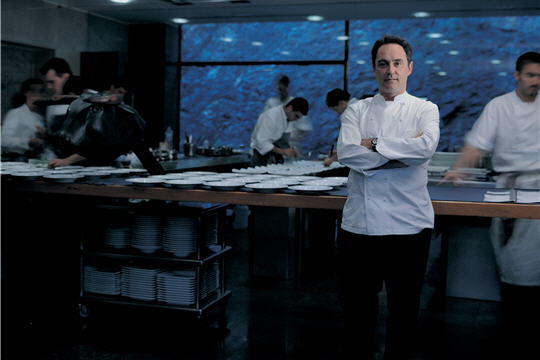
For those that don't know, El Bulli is considered one of the top restaurants in the world. The restaurant, which is closed from October to March, is almost impossible to get into and a dinner there is very expensive. To get a reservation, you must call in mid October for the following year, except if you don't call on the first day or two, you'll be out of luck. The man in the photo above is head chef Ferran Adria, who is credited with the creation of "molecular gastronomy," though it seems he wishes that term would go away.
He has published 5 huge books that are called "general catalogues" and document all the dishes the restaurant had on its menu over a certain period of time. It's not a cookbook as no home kitchen has all the tools needed to prepare his dishes and even if you did, you still couldn't make them. It's more to offer inspiration and get one thinking more about food. These books are insanely expensive (well over US$200) and, thanks to a great library, I finally have my hands on one (at least for a brief period), the 1998-2002 edition. So I'm very, very excited now!
While I've never been lucky enough to sample Adria's food, I did have the opportunity to eat at one of his discpile's restaurants in Washington, DC. Jose Andres has 3 VERY popular restaurants in DC, Zaytinya, Jaleo, and Cafe Atlantico. These places serve simple, true to their respective region cuisine, but the main attraction of the Andres empire is the restaurant within a restaurant, Jose's Minibar inside Cafe Atlantico. The Minibar is where Andres shows off the influence of Adria with an abundance (around 35) of delicious small courses. It's not the kind of food you'd want to eat every night and its not for everyone, but for those interested in something new and totally rethinking what food is, its well worth checking out. My meal at the Minibar is one of the most memorable meals I've ever had in the United States.
And the pictures, as usual. This is food as artwork just as much as it is food as food:
 The chefs at work
 the famous foie gras cotton candy
 meat and potatoes: thin slices of top quality steak served on top of a potato foam with a truffle (heavily) scented napkin
 Lobster Americaine: You eat the lobster bite off the syringeand then squeeze the soup into your mouth.
2007/02/12
January Book Review
 |  |  |  |  |
 |  |  |  |  |
 |
Hopefully, this is to become a monthly feature, renewing a (brief) tradition from the old xanga blog. I fear that next month I'm not going to have very many books to talk about because I haven't been doing too much reading (and I actually still have 50 or so pages of the MacFarquhar book). I'll start out by talking about the Mamet book, Wicked Son, because that is the only one that doesn't fit into any of the other categories. It was a good quick read that hit home, but in a lot of ways doesn't really apply to me, so let's move on...
Category 1 - Politics
The political books were all written by prominent Democrats and were all pretty much the same thing written by 5 different authors (2 of the books had 2 authors) to make 3 times the money. The Democrats need to win back the social issues, blah, they need to regain their image of being strong on national security, blah, they need to work to reunite the country, blah. Okay, I don't mean to downplay these things, they are all crucial points, but I think after reading them over and over and over again, I slowly lost how these are important commentaries on the direction of our country and instead saw them as an oversimplified picture being sold to those outside of the much talked about "gang of 500" who dream of being "players" in that "gang" and so buy such books. Fortunately, I have a great library at hand so I didn't have to pay for any of these books. As I said, many of the points are very valid and fortunately the Dems were willing to implement a lot of them and win back Congress this past year, but things may start to come apart again in late 2007 as the primary bulldogs sink their teeth into each other.
Category 2 - Cookbooks
Once you've read one Jamie Oliver book, you sort of know what to expect, but I like his recipes because they are pretty simple, usually turn out good, and the books/recipes are well written. The Asian Grill and The Irish Pub books were good for some ideas and possible alternatives to certain recipes, but the Asian recipes are closer to fusion and if you're looking for an Irish cookbook, I'd recommend one of the Paul and Jeanne Rankin books (though, admittedly those are more focused on "new" Irish cuisine). Now, Dok Suni is like a new bible for me. I love Korean food and for whatever reason, I've always had the impression that its so much easier to prepare than Chinese food, and Dok Suni made it seem even simpler than I'd imagined. It has all of my favorite dishes and for the most part, the recipes are good at creating authentic Korean flavors. The problem is that some of the recipes seem to leave some things out and so unless you have a Korean mother (or Korean friend or another Korean cookbook at hand), its definitely a process of trial and error before perfecting it, but isn't that what cooking is anyway? Then again, if you're struggling, there is always the website, My Korean Kitchen, which has never let me down.
Category 3 - CHINA
I know, I know, what you've all been waiting for, right? Over the years, I've read what feels like almost every book out there on China and so its hard to find new ones that I like, but this month I've been a bit surprised. The book on Li Lisan, Before Mao, almost lived up to the drama and romance that the dust cover promised. A google search for Li Lisan turns up around 15,000 hits, though it appears many are connected to this book while a search for Mao Zedong turns up over a million hits. Inside China, Li's far from a well known figure, despite the extent of his work and dedication to the Communist cause. I only heard a little about him from grandparents and relatives that had a vague memory of him from his days in Dongbei. This is sad at almost every turn and, in that sense, sort of reminded me of the movie, "To Live."
Chinese Lessons, by John Pomfret, was an interesting romp through China's history, touching on everything from the Cultural Revolution (through the stories of his classmates) to the reform and changes of the early 80s (when he first arrived in Nanjing), to Tiananmen (where he was a reporter), to the changes of the 90s (through the stories of his classmates), up to the present including, for good measure, F---- Gong (with his return as a reporter). I am convinced a "popular" book can't be published on China in the West if it doesn't talk about the Cultural Revolution, Tiananmen, or F--- Gong, and this one hit on all three. In doing so, however, it offers an interesting look at the country for those who are just getting to know China. For those "old China hands," there isn't very much, but it can be interesting to notice the same "types" of people that Pomfret talks about (the lovable loser, the person who keeps on fighting in the face of adversity and finds happiness in the end, the ethically challenged with a desire to reach the top) amongst one's friends and colleagues.
MacFarquhar's book, Mao's Last Revolution, is not something that the average person would want to pick up. Unless you have an intense interest in the Cultural Revolution, have a lot of time on your hands, and/or are a scholar, there's no reason for you to start reading this 462 page monster (609 if you include the notes). I guess its interesting to see things through the eyes of the Party (the authors focus more on the leadership than anything) instead of the common people, which is typically what you see in the Cultural Revolution memoirs published in the US. Then again, most of the leaders suffered equally (or worse) than those "common people." It also shows how out of control things were around the nation, instead of those other books which can only focus on the area where that person was, and how little control the central government had over things.
So out of all the books I've read this much, my main recommendations are for Dok Suni if you like to cook and want to learn about Korean food and Before Mao, a great nonfiction story that almost reads like fiction about love of a principle and love of a woman. If you're looking for an introduction to China, pick up Chinese Lessons, but otherwise you may want to consider something else.
Subscribe to:
Posts (Atom)


