Google
Showing posts with label minorities. Show all posts

2008/11/22

What Are They Thinking?

I try to stay away from blogging on the weekend, but there's too much to talk about this weekend, so here goes.

T!betans the world over are coming together in Dharmsala this week to discuss how to proceed in their dealings with the Chinese government. The meetings have taken on greater significance for two reasons, following the March riots in T!bet the calls for independence (and even violence) among some T!betans are louder than ever, and beyond that there is the pressing question of who will take over after the DL (abbreviated to avoid the Great Firewall).

The major issue is what comes after the DL? I talked about this a little in March after the riots and I still think this is critically important. If the T!betans hope to reach any kind of agreement with the Chinese government, it must happen while the DL is still in power. If they fail to do so, it's going to be a lot harder than they thought, why?

One thought is that the Chinese are convinced once the DL is out of the picture, they'll be able to name his successor and be able to slowly placate those who are in T!bet. Another possible line of thinking is that the DL is such a strong symbol of T!bet, a Nobel Prize winner famous the world over, but his successor won't be able to cultivate the same strong cult of celebrity.

The Chinese can be equally confident they don't need to be concerned about radical T!betan youth attempting to push for independence. As long as the DL is alive, the majority of T!betans will follow his "middle way" path, which was confirmed by their decision at the conference. The funniest part of an NY Times article on the conference states:
An independence movement, he [Jamyang Norbu, a T!betan writer in the US] said, would unite the exile community, keep T!bet in the headlines and increase pressure on the Chinese government. Supporters would organize economic boycotts of China. Young T!betans in the West would go door to door explaining the cause.
What? Economic boycotts of China will be impossible to organize except among some of the most ardent T!betans and some wacko leftists and will have no effect. They'll also fail miserably at getting much news coverage and creating any pressure on the Chinese. But the best part is the idea of monks going door to door in the US. Jehovah's Witnesses and Mormons, the club of crazies, that's the club you want to join?!? I always pictured Tibetan buddhism as far more noble.

However, what's more laughable are the radical T!betans, basically terrorists, who are calling for violence against the Chinese. Not only does that go against everything they purportedly believe in as Buddhists, it will quickly get them denounced around the world, as well as quickly crushed by the Chinese.

An agreement must come while the DL is still alive, or else the Chinese will have little patience for negotiations. Without the DL, China will be under even less international pressure than the marginal pressure they're under now and they'll also be able to split the domestic T!betan community.

2008/05/13

What Will Be Rising Out of the Inner Mongolian Desert?

I can’t remember in what expat rag I first heard about businessman Cai Jiang’s project at Ordos (Urbane perhaps?), a town in the middle of the Inner Mongolian desert. It seemed interesting and unique, but I didn’t pay it much mind until I came across a long article in the New York Times about the project. Basically Mr. Cai is building a brand new district in Ordos, which is to consist of everything you’d want in what will basically be a new town: office buildings, apartments, museums, and malls, many that will be designed by world famous architects. The crowning touch of Ordos, though, is its 100 villas that are to be designed by 100 of the world’s hottest architects. They are to serve as housing for the rich, but also a sort of outdoor architectural/sculpture park.

The thing that most readers will probably take from the article is this part:
Not long ago, residents of this region 350 miles west of Beijing lived in elaborate tents called yurts. Now, with a population of 1.5 million, many live in homes that would make New Yorkers jealous. According to Bao Chongming, the regional vice-mayor, they have the second highest per-capita income in China (trailing only Shanghai, the country’s financial capital) and an annual economic growth rate of 40 percent.
I know, I know, you went back and made sure you read that right and, you did. The second highest per-capita income in China. Annual economic growth of 40% (mainly in coal and dairy). Granted, those stats are coming from a “regional vice-mayor”, not always the best source for accurate statistics, but even if they are remotely true, its absolutely shocking. Ordos is a city that almost no foreigners and very few Chinese, have ever heard of. And while it’s population of 1.5 million people might seem big by US standards, that’s small potatoes in China.

It will be interesting to see what comes of this, the artist Ai Weiwei, whose in part responsible for the Bird’s Nest design and is behind the Qu Nar restaurant in Beijing, is heavily involved in this project. The article explains that the architects picked were given free reign to design with very little guidelines, leaving one to wonder how integrated the villas will be. It sounds like it might be a situation where there are 100 beautiful individual homes, but when viewed together, it is complete chaos. The article also brings up the very real issue of environmental concerns when putting together such a large scale city project where now there is almost nothing.

Inner Mongolia has long been famous for its grasslands, beautiful prairies of great open space, will Ordos change all that? Will it become known for a sparkling city pushing the envelop of modern architecture in a country that’s already on the cutting edge or will it end up a desert disaster?

2008/03/16

Wrong On All Sides...

It was a strange feeling after having a wonderful weekend to come into the office today and be greeted with tons and tons of articles about unrest in that southwestern special autonomous region in China with all the mountains whose name begins with a T.

Leaders in the Tibetan government have claimed that protesters have killed multiple people, and created extensive damage burning and looting around Lhasa. While the killings appear to be unconfirmed (the government has a strong grip on the region, especially when it comes to foreign media), from what I've read and heard, the looting of stores and burning of cars and other property has been supported. This appears to not be something brought on by any specific policy of the Chinese government, simply a "remembrance" of 1959. From the reports, it appears the Chinese government has done a pretty restrained job of dealing with some pretty unruly protests, though rubber bullets may have been used.

If this is really the case, if the government has been restrained and the protesters have behaved so horribly, why not lift the veil and let the people know? What better way to sway opinion onto your side? Something tells me that its because the truth lies somewhere in the middle. It's kind of interesting how the Great Firewall is working overtime now, I could access a story on IHT, but was unable to feature another one about that 73 year old who won the Nobel Prize and who left Tibet to go to India, let's call him the DL, even with anonymouse. In fact, trying to view a number of sites, it appears anonymouse wasn't able to defeat the firewall.

I may sound like a shill for the government, but I don't care. I'm most disappointed in the role that the DL is playing in all of this. If anybody has the ability to stop this, it's him, and yet he's pretending that he is "powerless" and has no role in any of the events. Dollars to doughnuts, if these protests weren't started by an order from him, they were definitely approved by him. Not only isn't he trying to stop them, but he's trying to stir the pot with statements about "cultural genocide." It's also an incredibly smart strategy to do this now, with less than 150 days to the Olympics, when it is certain that the media will pay attention and nuts the world over will start saying China is "unfit" to hold the Olympics. Great way to hijack coverage...

2007/03/21

Learning Chinese Becoming Too Common? Try Manchu!

In my school days, I remember someone mentioning that a fellow clashttp://www2.blogger.com/img/gl.link.gifsmate was studying Manchu (along with a number of other languages) on his own. These kind of language freaks, for whom learning Chinese isn't enough and so they move on to Mongolian or Tibetan or some other minority languages, were not altogether uncommon at my university considering its relatively strong languages program. Despite being part Manchu, I've never studied (nor ever thought about studying) Manchu. According to wikipedia, out of the 10 million ethnic Manchus, less than 70 can speak Manchu.

For whatever reason, this week the New York Times decided to take notice of this fact and came out with not 1, but 2 articles on the Manchu language. I can see it now, when the writer http://www2.blogger.com/img/gl.link.gifproposed the article, the editors thought a paid trip up to the middle of nowhere for one article wasn't enough, so the writer put together 2 stories. The stories are "Chinese Village Struggles to Save Dying Language" and "Manchu Language Lives Mostly in Archives." Hmm...What do these articles tell you? It seems that if you are fluent (or close to it) in Chinese and also have a solid grasp of the Manchu written language, you certainly have a longterm job prospect (though don't think the pay would be very good). Granite Studio does a good writeup on the articles (suprisingly one of the few in the China blogsphere who took note of them), but, possibly because I'm less of a romantic, I don't exactly feel sad about the disappearance of the language. Of course, there is a side of me that wants to go out (or at least go on amazon) and buy THE book to study Manchu, but amongst the other Manchu people I know (and in my own thinking), the idea that the language is eventually going to disappear is a foregone conclusion and doesn't make them any less proud in their own identity.

Music of Minorities 1 - Siqin Gerile (斯琴各日乐)

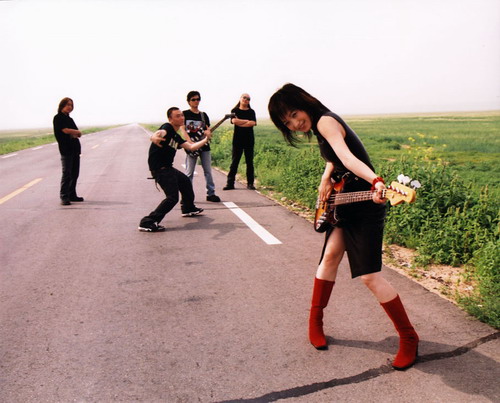
siqin gerileIts hard enough coming up with good content for the blog, but mp3 posts are particularly difficult, especially putting together the content (I know, I know, I should stop whining about it). One subject that I thought might work is minority music, especially those artists who have went mainstream with it. Arguably, this thread started with Cui Jian, as he is ethnically Korean, but we'll kick it off with Gerile, a favorite of mine. Obvious future entries could be Han Hong, Dao Lang, and...well, not sure beyond that. So, on to Siqin Gerile, for those interested here is her webpage and here is the blog...

Gerile is born and raised in Inner Mongolia and (if it wasn't already obvious), she is ethnically Mongolian. Her first album called New Century (新世纪)was released in 2001 to much popular acclaim and led to an appearance on that year's Spring Festival special. I really enjoyed that album, though I haven't really followed her career much since (which has included 2 more album releases). She has a very interesting style, remaking some old school sohttp://www2.blogger.com/img/gl.link.gifngs, using some traditional elements, and throwing in heavy guitar riffs and rock or techno music. Without further adu, the music:

斯琴各日乐 - 山歌好比江春水
斯琴各日乐 - 故乡 : Siqin Gerile - Hometown
斯琴各日乐 - 新世纪 : Siqin Gerile - New Century
斯琴各日乐 - 捍卫 : Siqin Gerile - Defender
斯琴各日乐 - 我自己 : Siqin Gerile - Myself

2007/03/01

Divas of Chinese Music 1: Na Ying

na yingI'm trying to come up with interesting subjects for the mp3 blogs. This is the first in a series on Chinese musical divas, I'm also thinking about one on minority music, and am willing to take suggestions on other topics. When I mentioned that I was going to write about Na Ying, I got criticized by multiple friends for using such "old" music that is no longer popular. Really? I would be shocked if people, even people in my age group, no longer listened to and appreciated Na Ying's music. For those who enjoy the mp3 posts that I've done, I'm very curious, what are you interested in hearing? I'm trying to figure out if this should be posting on the latest music (and I do intend on putting up newer music) or if you're more into finding out about the "classics" of Chinese music, so please leave comments or send emails.

Okay, on to Na Ying. She is originally from Shenyang (yeah!) and is ethnically Manchurian (double yeah!). This diva is now 40 years old, though she's aged very gracefully. She hasn't released a new album since 2002, but much of that is due to the pain she has been through in her personal life (though that pain is rumored to have inspired those albums in 2002). The star had what seemed like a storybook relationship with Gao Feng, a former Chinese soccer star, sort of the China version of Posh and Becks, if Posh was 10 times more popular and if people started referring to Becks as Mr. Posh Spice. Anyways, she kicked the cheating bastard to the curb and is getting things together (here's the news about her on sina (sorry, only in Chinese)). Alright, here's the music:

那英 - 梦一场 : Na Ying - Dreaming
& 那英 - 梦醒了: Na Ying - Waking Up From A Dream
These two songs are kind of like part 1 and 2, both come from the album "Conquer" (征服)and are 2 of my favorite songs of all time.

那英 - 一笑而过 : Na Ying - Passing Smile
Another one of her great ballad songs...

那英 - 一切都变了 : Na Ying - Everything's Changed
This is a song that comes out of her last album in 2002, representing much of what she was going through at the time.

那英 - 象我这样的情人 : Na Ying - A Lover Like
那英 - 相见不如怀念 : Na Ying - Missing You is Better Than Meeting You
Here are two songs that show she isn't just about pure ballads. I'm pretty sure the second is from a movie soundtrack, though can't remember which one...


Alright, so that's Na Ying for you. If it peaks your interest, I would either purchase a "Greatest Hits" album or go with "Conquer," a great album from start to finish that truly defines her style. And as usual, a bonus video:

2007/02/22

The Godfather (or "Take the Gun, Leave the Jiaozi")

Cui Jian is considered the father of Chinese rock music, but he's probably the father of all modern mainland Chinese music. Until he came along, Chinese music was all about patriotic songs and weak attempts to copy the love ballads that were coming out of Hong Kong. I don't think its a great overstatement to say that Lao Cui's impact on a generation of Chinese can only be compared to the impact of the US' 1960s counterculture's preferred groups combined (update: or is he China's Bob Marley?). Lao Cui, who is Chinese Korean, and his band ( a mixture of Chinese and foreigners) spoke to a generation with little to do on campus in a country that was starting to change and open up more. I was too young to really appreciate his music, its the generation before me, those who are in their mid-late 30s, who came of age during the time period when Lao Cui's music was at its apex of popularity. I heard his music, but never really paid much attention to it.

I left China before that fateful summer of 1989, but when intellectual curiosity caused me to start picking up whatever possible books I could find on China in high school (books almost always on the events of that summer), I kept coming across the name "Cui Jian." When I returned for the first time in 1998, I wanted to make sure I could buy whatever I could of Cui's music, but after a few listens, I gave up on that pretty quickly. Being used to US music circa 1998, Lao Cui's late 80s-early 90s "rock" hardly qualified as such. His songs almost always had long, instrumental solos, often a sax or a trumpet (Cui was classicly trained on the trumpet from a young age).

After releasing "The Power of the Powerless" in 1998 (buy it on amazon), it seemed Cui was comfortable just sitting back, playing the role of elder statement in the rock scene, encouraging young groups both with access (through his club venue), money, or simply encouragement. He also went into acting, playing the role of the father in one of my all time favorite movies, 我的兄弟姐妹 ("Roots and Branches") and I defy you to watch that movie without crying! Then suddenly in 2005, influenced heavily by hip hop music, Cui released a new album where these new influences are quite obvious, but it still retains its Cui-ness. I decided to attend his 2005 concert in Beijing just because it seemed like a happening, I was going for the classic Chinese reason, to "kan renao", but his performance and the rapt attention paid him by his fans really won me over (or maybe I'm softening in my older age). Anyways, enough talk, let's get to the music!!

崔健 - 一无所有 : Cui Jian - Nothing to My Name
this is the song that started it all, the song that was so popular and iconic to the Tiananmen generation.

崔健 - 出走 : Cui Jian - Escape
this is a song that I "discovered" at the concert, it has the same feeling as "Nothing to My Name," but it portrays those emotions in a different way.

崔健 - 超越那一天 : Cui Jian - Get Over That Day
This is a song off his newest album and shows off that mixture of classic Cui, with newer styles of music, including hip hop and techno. I can't say I love all the new songs (well, I never was a huge fan of his), but its impossible not to respect him for his attempt to change up and modernize his style when he could have just lived off all his old hits. I think his change of styles is a sign of how truly talented he is as a musician.

ps: Sorry for yesterday's rant (stupid Gestapo cops aside). I'll leave you with a bonus video (I love this video, it shows a lot what Cui is about, with emotions that are meant for a girl, but equally applicable toward China). For those interested in more of Lao Cui's music, I'm adding his greatest hits to the suggested reading list on the right (in this case, listening). Also, keep in mind that mp3s will only stay up for a week or so.