While laowai love to chase after "authenticity", they won't give up creature comforts for their desire to be "authentic", they'll find other ways to make up for it. For this reason, laowai overwhelmingly prefer Shanghai to Beijing.
Nas raps about the "acceptable negro" (ie Bill Cosby types, NOT Chris Rock types) and Shanghai is an "acceptably Chinese" city. It isn't necessarily a matter of racism, but more about societal norms and what one's been exposed to. The city is very much Chinese, but there are still parts that don't feel like China, this pleases the laowai. The number of foreigners in Shanghai and the excellent selection of foreign restaurants also makes the laowai comfortable. Yet the laowai can also have a very "Chinese" day and satisfy his desire to feel like he's in China. While short-term visitors typically prefer Beijing for its "authentic" Chinese "feel", the true laowai (ie the expats), love Shanghai for its creature comforts and how it mirrors their life back home in New York or London or Los Angeles.
The laowai will quickly identify himself with all things Shanghai and will lust after a French Concession mansion, thus fulfilling his desire for history(very important to laowai), authenticity, as well as all the comforts of modern living (once they fix it up, something laowai love to do).
While the laowai might have many favorite spots around China (hint hint Yunnan and Tibet, coming soon), he will call Shanghai home and will forever prefer it to its "Grandfather" up north.
2008/05/14

Post-Tiananmen Patriotism
There have been a lot of articles about the trend of rising patriotism among the younger generation in China. These discussions are nothing new especially in light of the situation in
T!bet, the torch relay, and now the earthquake, all events that have raised the national fervor in China. I’ve read a number of similar articles and for the most part, they’ve bored me, except for one in particular which raised some interesting points.
The statement that struck me the most was:
I started thinking about this even more and there is definitely a point there. The “1989 generation” was liberal and very much open to western ideas. They were, and still are, very open to westerners and the concepts that they believed in during the leadup to what happened that year. After the events of that year, many of them went abroad and studied, came back, made a lot of money, and are generally happy.
After 1989, the country was basically on lockdown and the focus was inward until after the reforms and Deng’s 1992 Southern tour. The new generation grew up in a less chaotic, more powerful China than any previous generation had witnessed. They also grew up in a far more polarized situation, the outside world still strictly condemning China for ’89, but yet still interested in trading with them.
The pre-89 generation was wayward, not sure what they were living for, the post-89 generation was sold on the need for national pride. This situation planted the seeds and every condemnation, every attack or “attack” (like the Belgrade bombing and spy plane incident), and every slight (real or imagined) caused nationalist sentiment to grow and strengthen to the point its at today, where even students at top universities and white collar employees are under its influence.
The scary thing is, as the article’s author stated, "Beijing's leadership, for all its problems, might be less hard-line than China's youth, the country's future." If China ever were to become a truly free political system, it might actually become more, not less, aggressive. The government got its wish, a youthful populace that is “under control” and exceedingly loyal, unfortunately, as the saying goes, be careful what you wish for. The test now will be how the government can control this new problem.
T!bet, the torch relay, and now the earthquake, all events that have raised the national fervor in China. I’ve read a number of similar articles and for the most part, they’ve bored me, except for one in particular which raised some interesting points.
The statement that struck me the most was:
Many middle-aged Chinese intellectuals are astounded by the differences between
them and their younger peers. Academics I know, members of the Tiananmen generation, are shocked by some students' disdain for foreigners and, often, disinterest in liberal concepts such as democratization.
I started thinking about this even more and there is definitely a point there. The “1989 generation” was liberal and very much open to western ideas. They were, and still are, very open to westerners and the concepts that they believed in during the leadup to what happened that year. After the events of that year, many of them went abroad and studied, came back, made a lot of money, and are generally happy.
After 1989, the country was basically on lockdown and the focus was inward until after the reforms and Deng’s 1992 Southern tour. The new generation grew up in a less chaotic, more powerful China than any previous generation had witnessed. They also grew up in a far more polarized situation, the outside world still strictly condemning China for ’89, but yet still interested in trading with them.
The pre-89 generation was wayward, not sure what they were living for, the post-89 generation was sold on the need for national pride. This situation planted the seeds and every condemnation, every attack or “attack” (like the Belgrade bombing and spy plane incident), and every slight (real or imagined) caused nationalist sentiment to grow and strengthen to the point its at today, where even students at top universities and white collar employees are under its influence.
The scary thing is, as the article’s author stated, "Beijing's leadership, for all its problems, might be less hard-line than China's youth, the country's future." If China ever were to become a truly free political system, it might actually become more, not less, aggressive. The government got its wish, a youthful populace that is “under control” and exceedingly loyal, unfortunately, as the saying goes, be careful what you wish for. The test now will be how the government can control this new problem.
2008/05/13
Drinking for a Cause
The new Emperor Hotel has announced that between May 13th and 16th, all proceeds from their beautiful bar, Yin, will be donated to the Chinese Red Cross and go to earthquake relief.
With the renovations of What? Bar, there has been a lack of any nightlife in the Tiananmen area (though this will change as soon as the Legation Quarter opens). Now, The Emperor Hotel has opened on Beichizi, just east of the Forbidden City, and offers a hot nightspot in the city center. This area, full of small touristy shops and hole-in-the-wall noodle places has been getting a dash of culture lately with the recent opening of the Zenith Art Gallery in a beautiful old building and now, The Emperor comes to town. The Emperor is a high-end boutique hotel that is part of the Design Hotels group, known for its very stylish hotels.
The bar at the Emperor, Yin, is the exact opposite of What? Bar, which was a dingy, loud, raucous spot to listen to live music. Yin has a very comfortable, relaxed spot with great rooftop views of the Forbidden City and the surrounding area.
Have a drink and help others!
A Lazy Foreigner's Look at the Beijing Dining Scene (Brought to You by the Wall Street Journal)
For a few months now, I’ve been frustrated with the quality of reporting coming out of China. It isn’t so much the news writers, but sports and features writers are coming to the capital and filing reports for folks back home in preparation for the Olympics, all too often just offering a guidebook glimpse of the city and failing to understand it. This time, a food writer from the Wall Street Journal works his lazy best on Beijing’s food scene. His recommendations and comments are straight of a Lonely Planet, giving knowledgeable readers the feeling that he could have written the article without even setting foot in one of the hutongs he talks about so much.
The writer states that: "the city has something else to offer attendees willing to venture beyond hotel and tourist restaurants: some of the best food on the planet.” Unfortunately, with few exceptions, he focuses only on tourist restaurants. The article talks about the “extremes of Chinese food”, listing a Crystal Jade fish dish that costs US$41 as the “most expensive” dish. Well, while it might be the most expensive out of the restaurants he chose, that’s far from the most expensive dish one could find in Beijing. Further, to call the Peking Duck at Liqun as the “most delicious” dish in Beijing is going a bit far.
He talks to 3 “foodies” to get his 8 recommendations, but these “foodies” qualifications are questionable at best. Let’s look at the choices:
Peking Duck – Liqun
Liqun has long been an expat favorite, probably because its in a hutong and its “authentic” because it is very run down. The restaurant is tiny, “inelegant” (as the author puts it), and the customer base seems to be entirely foreign. The duck is good, but isn’t outstanding and for my money, even though it is high on pomp, Da Dong’s duck is still the city’s best (with City Hotel’s restaurant in 2nd and Bianyifang in 3rd). Compared to those, Liqun’s just average.
Beijing Snacks – Jiumen Xiaochi
Another very popular hutong spot on every tourist’s list. It is one of the few places around to still sample many of the local specialities. The problem is, this place really isn’t very good, there are much smaller local places around that offer some of these dishes, but not many options to find them all in one setting. I still prefer the area around Huguosi for my Beijing snacks, but I can’t really complain too much about this choice, though why not sample another Beijing speciality, zhajiang mian at one of the many good options (like Lao ZhaJiangMian Wang)? Or what about the local chicken wings for places with real personality?
Tan Family Cuisine – Guo Yao Xiao Yu
Another hutong spot, are you starting to see the pattern? I’ve never been to this spot so I won’t say much about it. From my understanding of “Tan Family Cuisine”, its an offshoot of imperial dining, and while the idea of this tiny restaurant in a hutong might be appealing to some, there are better choices that aren’t necessarily on the tourist path. For my money, I’d go with Na Jia Xiao Guan, an excellent restaurant with an interesting design and always a huge line out front.
Guizhou - Jun Qin Hua
4th pick and 4th hutong you’d be entering. He describes this place’s Guizhou style lazi ji as the spiciest dish in China, though I highly doubt it could compare to a Chongqing style hotpot at Hai Di Lao. He completely misses the fact that while Guizhou food is spicy, it is a very different spicy from what you’ll find at the Hunan or Sichuan restaurants that foreigners are more used to. Guizhou food often incorporates sour flavors to cut the spiciness, not mentioning this is sort of doing a disservice to the reader. However, I do give him credit for not going with the easy choice of 3 Guizhou Ren.
Beijing Dumplings – Xian Lao Man
What can I say, this place does offer excellent dumplings and so I can’t complain too much about its inclusion.
Beijing Congee – Hong Zhuang Yuan
I’ve never heard of “Beijing congee” before, and typically consider this a very southern dish. Never been to this restaurant and therefore don’t want to say too much about it, though it seems like he was just trying to mix it up by throwing in a cheaper restaurant.
Modern Beijing – Hua Jia Yi Yuan
This place is excellent and draws in a pretty Chinese customer base, I have no complaints with its inclusion on the list.
Hakka - Kejia Xiao Zhen
I’m not a fan of southern food and wouldn’t really choose to eat Hakka food in Beijing. I don’t have too much to say about this place except, you guessed it, yet another hutong restaurant
Sichuan – Fei Teng Yu Xiang
This is a place that is popular with foreigners due to its Gongti location, but does get a decent amount of locals as well. The food’s good, but for the price, I’d go to the much classier South Beauty or Yu Xiang Ren Jia, which are just as good, and of course, the always popular Chuan Ban. Then again, there are many great choices for Sichuan food in Beijing and it’s kind of hard to go wrong.
Actually, this article (and the overwhelming choice of hutong dining), is connected to Stuff Laowai Like. Laowai favorites included in the article are: hutongs (coming soon), authenticity (coming soon), "local specialities", and contrasts.
On the Subway 4: Style Police
In the winter months in Beijing, everyone starts to bundle up and fur, sometimes real, more often of questionable origin, becomes an inevitable sight, as lining on coats, in/around hoods, and in totally fur coats. All too often, the fur isn’t even real fur, as chronicled by Stylites.
One day on a crowded Beijing subway car, there was a short, thick man (most likely from Dongbei) in a (very fake) fur coat, the type of coat that (if real) would only be worn by pimps and professional athletes in the US. It was hard not to notice him, but it’s not exactly an uncommon sight, one I’d only warrant a peak at and nothing more. However, a young French guy standing next to me conversing with his Chinese girlfriend thought it was much more important than that.
Frog: Do you see that guy?
GF: Yes, what?
Frog (excitedly): DO. YOU. SEE. THAT. GUY?
GF (even more puzzled): yes, what is so special with him?!?
Frog: He’s wearing a fur coat.
GF (perplexed): so?
Frog (perplexed and excited): He’s a man, he is wearing a fur coat.
GF: Do you have a fever? What’s wrong with you?
Frog (indignantly): He’s a MAN! Doesn’t he know that men don’t wear fur coats? What? Is he gay?
GF (pounding her head against the pole)
Ahh, don’t you just love the French?The US may serve as the “world’s police force”, but the French want to be the globe’s fashion police. My “biglaw” dreams and the salary that goes with it may have brought me to Japan, but the lack of these sort of exchanges have led me to miss Beijing on a daily basis.
What Will Be Rising Out of the Inner Mongolian Desert?
I can’t remember in what expat rag I first heard about businessman Cai Jiang’s project at Ordos (Urbane perhaps?), a town in the middle of the Inner Mongolian desert. It seemed interesting and unique, but I didn’t pay it much mind until I came across a long article in the New York Times about the project. Basically Mr. Cai is building a brand new district in Ordos, which is to consist of everything you’d want in what will basically be a new town: office buildings, apartments, museums, and malls, many that will be designed by world famous architects. The crowning touch of Ordos, though, is its 100 villas that are to be designed by 100 of the world’s hottest architects. They are to serve as housing for the rich, but also a sort of outdoor architectural/sculpture park.
The thing that most readers will probably take from the article is this part:
It will be interesting to see what comes of this, the artist Ai Weiwei, whose in part responsible for the Bird’s Nest design and is behind the Qu Nar restaurant in Beijing, is heavily involved in this project. The article explains that the architects picked were given free reign to design with very little guidelines, leaving one to wonder how integrated the villas will be. It sounds like it might be a situation where there are 100 beautiful individual homes, but when viewed together, it is complete chaos. The article also brings up the very real issue of environmental concerns when putting together such a large scale city project where now there is almost nothing.
Inner Mongolia has long been famous for its grasslands, beautiful prairies of great open space, will Ordos change all that? Will it become known for a sparkling city pushing the envelop of modern architecture in a country that’s already on the cutting edge or will it end up a desert disaster?
The thing that most readers will probably take from the article is this part:
Not long ago, residents of this region 350 miles west of Beijing lived in elaborate tents called yurts. Now, with a population of 1.5 million, many live in homes that would make New Yorkers jealous. According to Bao Chongming, the regional vice-mayor, they have the second highest per-capita income in China (trailing only Shanghai, the country’s financial capital) and an annual economic growth rate of 40 percent.I know, I know, you went back and made sure you read that right and, you did. The second highest per-capita income in China. Annual economic growth of 40% (mainly in coal and dairy). Granted, those stats are coming from a “regional vice-mayor”, not always the best source for accurate statistics, but even if they are remotely true, its absolutely shocking. Ordos is a city that almost no foreigners and very few Chinese, have ever heard of. And while it’s population of 1.5 million people might seem big by US standards, that’s small potatoes in China.
It will be interesting to see what comes of this, the artist Ai Weiwei, whose in part responsible for the Bird’s Nest design and is behind the Qu Nar restaurant in Beijing, is heavily involved in this project. The article explains that the architects picked were given free reign to design with very little guidelines, leaving one to wonder how integrated the villas will be. It sounds like it might be a situation where there are 100 beautiful individual homes, but when viewed together, it is complete chaos. The article also brings up the very real issue of environmental concerns when putting together such a large scale city project where now there is almost nothing.
Inner Mongolia has long been famous for its grasslands, beautiful prairies of great open space, will Ordos change all that? Will it become known for a sparkling city pushing the envelop of modern architecture in a country that’s already on the cutting edge or will it end up a desert disaster?
The Earthquake, Rumors, and What Might Be Coming
First, here at A Modern Lei Feng, our heart's go out to all those in Sichuan and around China who were affected by the 7.8 earthquake that hit near Chengdu yesterday. We will be donating money and doing what we can to help and encourage others to do the same.
There is not much we can add to the earthquake reporting, while it was felt in Beijing and Shanghai, it didn't create real damage and only those in high rises knew that it was even happening. I do agree with others, this is yet another bad sign in what was supposed to be a very lucky year for China. Beyond the snow storm, the T!betan protests (and the torch relay aftermath), and now this earthquake, there is hand, foot, and mouth disease that has been spreading through interior provinces, the Qingdao train accident, the thwarted terrorist attack in Xinjiang and the possible "terrorist" attack on a Shanghai bus, plus rumors about potential terrorist attacks against transportation targets in Beijing. At this point, China has been struck with so many disasters, both natural and man-made, what's next?
So what more can we offer? For those in Beijing and Shanghai, the earthquake wasn't so scary, but fear spread when rumors started circulating widely about aftershocks that would measure between 3 and 6 on the Richter Scale and would take place between 10 pm and midnight. This was sent as a legitimate SMS and was received over and over again, it even made it onto some reputed (if there is such a thing when talking about Chinese media) media websites, though it was quickly removed.
In the US, usage of text messaging is relatively limited while in China it is used by everybody as its cheaper than a phone call and often more convenient, especially when on a packed bus or subway. Usage of SMS is one of the main ways rumors spread so quickly (ie the AIDS Kabab rumor as another example). Rumors tend not to spread so much in the US because they often are sent through email and the reader has full usage of the internet to check the veracity of the rumor. In China, even when the text message defies logic (ie being able to predict the time of an earthquake, AIDS spread through food), the number of times you receive them and how they are often sent from otherwise highly intelligent individuals makes it harder to ignore.
2008/05/09
Only in America, Where Brand Rule...
Last year I did a post on the many different Starbucks locations Beijing has to offer and the "personalities" of many of these shops. Well, I've recently found one that takes the cake!
Waiting to enter the US Embassy, I saw the familiar Starbucks mermaid logo peaking out at me through a window. At first, I thought it was only a reflection and so I turned around only to find the Bulgarian Embassy complex, not a Starbucks. Upon entering the grounds of the US Embassy, I quickly discovered that my eyes weren't playing tricks on me, smack dab in the middle of the complex is that most famous of Seattle coffee shops.
It doesn't surprise me that diplomats want to drink coffee too, and they probably don't want to stand in line like everyone else at the nearby Xiushui or Yonganli locations. Still, there was something very weird about seeing that famous logo on the grounds of the Embassy. No, its not quite as bad as seeing the circular Starbucks sign in the Forbidden City, but its truly, uniquely American. Ahh yes, I feel so happy to be on US soil, where brands reign supreme, let me celebrate with a iced, tall latte. Come on, can you imagine a beer hall in the German Embassy? A wine bar in the French Embassy? Only in America...
Anyone have an even stranger Starbucks sighting?
On the Subway 3: Will Free Transportation Turn Out to be a Nightmare?
Having picked up the Olympic tickets I was (luckily) able to purchase in Phase 3 and, being a lawyer, I flipped one over and read the "fine print" (otherwise known as the Terms and Conditions) on the back of the ticket. There were 12 Terms with the most interesting of them being the last one:
That is, until I came across a post on Zhongnanhai's great blog which warns of heightened security in all subway stations, including x-ray machines, by July. If this turns out to be true, it could make the daily commute bad enough on an average day, but I can only imagine how insane it will be come the start of the Olympics. Please, say it ain't so?!
You may use your Ticket to travel for free on the date marked on your TicketWow! This will make things very nice for anybody with tickets to an event and this also represents a huge, HUGE loss in profit for the city. It is really a wonderful gesture that Beijing is making and I tip my hat to them.
(until 4 a.m. the next morning) by public bus and subway within the Beijing
Municipality (excluding passenger transport to suburban districts and counties,
and the airport express. You are responsible for checking transportation
information and setting aside enough time for security inspection.
That is, until I came across a post on Zhongnanhai's great blog which warns of heightened security in all subway stations, including x-ray machines, by July. If this turns out to be true, it could make the daily commute bad enough on an average day, but I can only imagine how insane it will be come the start of the Olympics. Please, say it ain't so?!
Blame it on Bjork
It feels like the May holiday was ages ago, despite the fact it was only last week, but for those music fans, the cancellation (or postponement) of the Midi music festival won't be forgotten anytime soon. The festival fell prey to "security concerns", but one has to wonder how much Bjork's famous statement during her Shanghai concert about a certain autonomous region in western China played a role in the government's decision. Bjork's brief moment of lunacy came before the madness that happened in March (and I'm not talking about college basketball!) and, especially in light of that, I can imagine the government's fears about what the many foreign acts coming to play at Midi might say.
One would think that many foreign music acts would want to come to Beijing this summer, especially before/during/after the Olympics, but it now looks like the government's fear about "disorder" and "security" may prevent this from happening. Right now, it doesn't seem like the government is going to relax anytime soon, in fact, things might get even more tense as we get closer to August 8th.
One would think that many foreign music acts would want to come to Beijing this summer, especially before/during/after the Olympics, but it now looks like the government's fear about "disorder" and "security" may prevent this from happening. Right now, it doesn't seem like the government is going to relax anytime soon, in fact, things might get even more tense as we get closer to August 8th.
Crazy Right Now...
Like everybody, I have a soft side for gossip. It's always fun to hear inside rumors and the like and for lawyers, the place to go for gossip is Above the Law. The website's focus is on what is affectionately referred to as "biglaw", the US' major law firms, and typically the New York offices of these firms. Granted, the majority of lawyers in the US don't come close to earning what the associates at these top firms earn, but it can still be interesting. The comments, a mixture of immature frat humor, real insight, and overall cattiness that would make the most gossipy high school cheerleader blush, are also well worth reading.
Recently, the site's focus has moved away from New York with a new feature called the "Asia Chronicles." The most recent post, Champagne Wishes and Caviar Dreams, paints a dreamy picture of what its like being an associate at a top firm in Asia. Sure, there are firms like Simpson Thatcher that pay a similar salary in Beijing/Shanghai/Hong Kong as in New York and throw in an $80,000/year housing allowance, that's right, HOUSING ALLOWANCE, as well, which will cause anyone, even some of those biglaw associates in New York to drool. Imagine what it's like for people at top Chinese firms who are working just as hard as associates at the foreign, biglaw firms, but can't even get a salary that matches a US firm's housing allowance! If you're in the industry and you aren't at one of those firms, it can bring tears to your eyes...
Let me tell you, there are very few firms that are paying at those levels. If you want to be in a China office (especially Beijing/Shanghai), you'll be earning a good salary, but beyond a very small number of foreign firms, your salary will be far less than what you are paid in New York. That's not to say your salary won't be very high for China, but expect low 6 figures, high 5 figures with a minimal housing allowance at best.
It will be interesting to see the future of this series, but from the first few articles, its quite obvious that it is (heavily) sponsored by a recruiter, who seems to be trying to drum up business by selling people on how great it can be to work in Asia. At the same time, the number of extremely racist comments are startling. Frat humor is one thing, but these comments cross the line and are a disgrace considering that they most likely came from highly educated US attorneys.
2008/05/06
100 Days, 100 Restaurants - Upscale Homestyle Hits Beijing
So here were go, starting off the 100 Days, 100 Restaurants series and not even going to begin talking about Chinese food, but forgive me for that, Beijing has many quality offerings of all kinds of food.
Over the past few years its been popular in the US to take "homestyle" cooking and "comfort food" and turn them into high end cuisine. There are currently a number of places in Beijing trying to take simple foods and turn them gourmet and we'll look at some today.
Korean
A few week back when having dinner with a prominent China blogger (no names), the topic somehow turned to Korean food and he stated how he regularly angered Koreans by referring to their food as "peasant" food. Even when I've had "upscale" Korean, back when Chicago still had a branch of Woo Lae Oak, the dishes weren't much different from what you'd find at a hole in the wall place in Koreatown. Well, in Beijing there are two places offering higher end Korean, but much like my Chicago experience, this isn't imperial style Korean food, its the same soups and grilled meats that can be found anywhere else.
1. Saveurs de Coree
From the French name, you know you're in for a different experience and when you walk into the stylishly decorated tiny dining room, your suspicions are confirmed. There isn't much decoration and the restaurant is very small, but it does have a wonderful rooftop terrace (arguably the best for al fresco dining in the area), making summer eating a great option. This is definitely a place that you need to contact in advance, but the nice thing is there are lots of choices in Nanluoguxiang. The menu features all the regular favorites and doesn't really diverge from what you'd get anywhere else, except the meats are served on sizzling plates instead of grilled in front of you. The nice thing is that all the hotplate dishes come with lettuce, vegetables, and dipping paste. Of course, all diners also get a decent selection of the requisite pancheon (including a good kimchi). The restaurant emphasizes that its Korean food is healthier than other places, the only place this is really noticeable is in the small portion sizes. The soon tofu was good and the dukbokki didn't disappoint, but both were a bit pricey. The spicy pork served on a sizzling plate (RMB58) was excellent, a bit charred, but that's just how I like it.
This place is a wonderful spot if you're looking for Korean food served a bit different and where you won't come out smelling of grilled meats. Prices are relatively reasonable considering the surroundings, but regulars at lower end spots or the Wudaokou Korean places will come away wondering why they paid so much and yet might not be full. Drink prices are high as well, especially when compared to the price of the food. In the end, its a great spot for a date, but not for a big meal with the guys.
Saveurs de Coree
29 Nanluoguxiang
东城区南锣鼓巷29号
6401-6083
2. Sorabel
Set in the swanky Lufthansa Center, despite the many changes around it, this restaurant has been in this location for many years. Fortunately, as Beijing has expanded, this spot on the northeast corner of 3rd Ring Road has slowly been surrounded by a larger and larger population from which to draw customers. Despite this, the customer base hasn't changed much, businessmen working in the area buildings and Koreans separated from the Wudaokou masses, as well as getting a sliver of the "women who lunch" business. It's your typical Korean barbeque, though in a cleaner and more posh setting. Prices are high compared to the other barbeque joints in the city, but reasonable considering the surroundings. If you're in the area or live nearby and have a hankering for Korean food, Sorabel can fill it, otherwise, it's not worth the trip as the city has many, better options.
Sorabel
Basement 1, Lufthansa Center
50 Liangmaqiao Lu
朝阳区亮马桥路50号燕莎友谊商城B1楼
6465-3388
Noodles
3. Noodle Loft
Noodles are a staple in any northerner's diet and are typically consumed at a neighborhood place where heaping bowls of daoshao mian (knife cut noodles) or niurou la mian (pulled noodles with beef) are served form RMB8 or so. Noodle Loft, from the people behind the other "Loft" restaurants, takes these northwestern staple dishes and takes them upscale, fortunately along the way, the prices stay somewhat reasonable. All noodle dishes are under RMB20, and while that may seem like a lot, for those working in the CBD, its nothing new. The difference is, the setting here is more like a fancy bar rather than a noodle shop. The noodle portions are small, with the popular items being the DIY daoshao mian (RMB12) and youmian (RMB16), which comes with 3 dipping sauces. Menu dishes range from around RMB25-50, and help satiate your hunger after the rather small bowl of noodles.
This certainly isn't your local noodle spot where a bowl of noodles is enough for a meal. In this high end environment, noodles are meant as just one course, alongside a variety of hot and cold dishes. The place definitely gives off a cool vibe and there's a lot to see, especially while watching the action in the open kitchen as the chefs prepare the variety of noodles. The Baiziwan location is even nicer than the Heping one, but the Heping one is easier to find and get to as its very close to the Heping Xijie subway station on Line 5 (easier, but still not that easy as its tucked into a hotel with little signage to guide you). It's noodles like you've never had them before and well worth checking out at least once.
Noodle Loft
Heping Xijie, JiSuanJi Chang Yuan Number 3
东城区和平西街计算机三厂院3号
5130-9655
2008/05/05
Stuff Laowai Like 1 - ABC/CBC Girls
On the list of Stuff White People Like, Asian girls come in at number 11 and is a top post on that site. For us, we think this should be number 1 on the list of Stuff Laowai Like. But not just any Asian girls, laowai guys, especially those who haven't been in China long and don't speak much Chinese are specifically into American Born Chinese/Canadian Born Chinese/Australian Born Chinese girls.
Why is this the case? Having just gotten off the plane in Beijing or Shanghai, the laowai male (in this case typically between 20 and 30 years old) with limited Chinese skills wants to find himself a woman, but he isn't as shallow as the old laowai papas who just wants any young thing, the younger guys want someone who they can talk to, share with, and bitch about "another China day." With rare exceptions, the majority of native Chinese women they meet at a Sanlitun/Hengshan bar speak only limited English and have completely different cultural values and thoughts. Therefore, these guys focus on the ABC/CBC girls in the crowd: Chinese looks and perfect English, plus somebody who can serve as their translator/secretary, what more could you ask for?
Unfortunately, these relationships often fail because over time, as the laowai male gets more acclimated to China, he wants to "go native" (and thus be more "authentic" something we'll be covering a lot in the future) and/or his ABC/CBC girl gets sick of her "duties" and/or she ends up returning to the US/Canada.
Stuff Laowai Like: Introduction
Inspiration can come to you at any time, its strange like that. One day, sitting in a lovely courtyard waiting for a meal and starving, a statement was made when looking around at other tables, "why do laowai like Yunnan food so much?" It was at that point it hit me, a new feature could be created and after a teleconference with the other writers, it was.
Stuff Laowai Like is our own take on the very popular blog (with book coming soon), Stuff White People Like. During the next few weeks, months, and possibly years, we'll look at and analyze those things that laowai like about living in China.
Now, we know laowai are a diverse group consisting of North Americans and Europeans that speak a wide range of languages, have huge differences in age, salary, etc etc. This will focus on the Canadian and American laowai in China as this is where we can offer the most insight, though we'll try to infiltrate the French and German laowai society here (anybody who can help with that, we'd greatly appreciate it). While there is such diversity among laowai, its still easy to accurately generalize about a large number of laowai in China and that's what we'll be doing.
Yes, perhaps we're biting off more than we can chew with yet another feature starting up and one (and a half) writer down, but we press on. Most of all, we must once again fight as blogspot is blocked, but again, we press on. As always, any suggestions or opinions about this new feature, please leave a comment or email us at modernleifeng@gmail.com.
2008/04/30
On the Subway 2: Improvement or Nightmare?
Waiting for a train in a Line 1 or 2 subway station you get a phone call, your friend is looking to meet you, but you haven't decided where yet, the train comes and you get on, your friend is babbling about a trieste he/she had the night before and just about to get to the juicy details when...The train leaves the station, enters a tunnel, the line goes dead, and you curse loudly, drawing the ire of your fellow riders, who are squeezed against every possible part of your body.
The above scenario has happened to us all, probably countless times, right? Well, no more according to the Beijing government, as they are expanding cell coverage in the subway tunnels meaning that by June, there will be no more dropped calls on the subway.
Whether or not this is good news, it depends on your outlook on mobile phones, are they a gift or a curse? For those who think our world is already too connected, you have one more thing to complain about as you are attempting to enjoy the "peace" (yeah, right!) of a Beijing subway ride.
2008/04/29
100 Days, 100 Restaurants
Today marks 100 days until the Opening Ceremonies to the Beijing Olympics and activities abound around the city. To honor this day, we at Modern Lei Feng have decided to launch a new feature as alluded to the other day, 100 Days, 100 Restaurant.
It won't be one restaurant per day, but will probably be broken down by style of food and other themes I can come up with, yet by August 8th, I will have reviewed 100 Beijing (and some in Shanghai, as its also an Olympic city) restaurants.
Realistic? Perhaps not, but its always good to have a goal.
It won't be one restaurant per day, but will probably be broken down by style of food and other themes I can come up with, yet by August 8th, I will have reviewed 100 Beijing (and some in Shanghai, as its also an Olympic city) restaurants.
Realistic? Perhaps not, but its always good to have a goal.
2008/04/28
Note to All Readers
I hate doing posts like these because I feel its pretentious and nobody really cares, but here goes. Despite the weekend photo threads and mp3 posts going by the wayside (mostly due to the destruction of my Macbook, though they may start up again), I'd like to announce a new feature, regular posts about the Beijing dining scene and restaurant reviews.
I have found localnoodles to be severely lacking in the number of reviews and other than the expat rags, there seem to be very few people writing about this scene. I also regularly find the expat reviews to be disappointing, so I'm writing my own. The focus will be on more popular places and will be almost entirely contained to places inside the 3rd Ring Road, except when I go way outside it to post about Shanghai, Shenzhen, and other locales.
I hope readers will enjoy the new posts and feel free to offer comments or suggestions about places I should check out. As always, I can be reached at modernleifeng@gmail.com.
What's Going On?
It seems like by now everything in this crazy world of ours is more or less back to normal, but to borrow the immortal words of Marvin "what's going on?" Let's review. The 2008 torch relay began and for whatever reason the government thought the torch would be greeted with great joy or perhaps basically get ignored, but instead thousands took to the streets in London, Paris, and San Francisco. After what happened in march, what was the government seriously expecting? At the same time, while the protests were an overwhelming statement of free speech, how many of those rallying for the cause of Tibet could actually point it out on a map? The fact that so many people went as far as getting arrested for a place they have never visited and probably know next to nothing about boggles the mind.
Then Paris, we'll always have Paris, right? The craziness of a torch relay where the torch doesn't stay lit and must ride on buses and the defining moment of the torch relay, when the Paralympic athlete in a wheelchair, Jin Jing, battled a frog and "bravely" protected the torch. I have to wonder about the sanity of a man who attacks a disabled girl for the cameras of the world. The Chinese backlash against all things french was immediate, Carrefour suffering the most and yet I still bet the lines will be long during the may holiday.
Back to the subject of Jin Jing, at first the articles barely even referred to her, but once Xinhua realized it had a pr coup on its hands, she was front and center. Netizens talked up her bravery and were calling her a beautiful angel. Maybe its the cynic in me, but the sudden publicity she's getting is disingenuous. She's a former Paralympic champion, but most Chinese have never heard her name before. After a week or two, this beautiful angel will go back to being ignored and jobless, but that's what happens if you're disabled in China. Unfortunately, her brief fame hasn't been used to shine a light on how she's treated in China, that would kill the instant patriotism.
Then there's CNN, that great bastion of American news, reporting to the world twenty four hours a day. One of its commentators made some idiotic, off the cuff comments about china and suddenly the whole country is up in arms. It is one thing for ordinary citizens to be pissed off, its another thing when the government starts attacking this individual. So you want to be a superpower but you can't take a little criticism from one lowly commentator? CNN should have immediately fired Cafferty (or for face, suspended him), but the government should be a little less preoccupied with the opinions of one relatively meaningless individual and a little more thick skinned. Finally, the lawsuit against CNN for 1.3 billion dollars, what can I say? Having worked for a federal judge, I thought I'd seen every possible desperate and/or laughable lawsuit there could be, but this one might take the cake. I'd love to read the brief if anyone has it, I'm sure it would be great for laughs. I can see it now, the moment the judge sj'd this thing out of court, Chinese netizens will once again rise up in indignation.
The world's done gone and lost its damn mind!
2008/04/27
Where Beijing Falls Short...
In the past one of my aunts was always complaining about how early things closed in Beijing and I always said that it wasn't quite as bad as she made it out to be, closing hours for a lot of the bigger malls was typically around 10 pm, which seemed reasonable. However, after spending a night at Wangfujing not too long ago and being in Tokyo now, I've come to agree with her, Beijing closes down way too early.
For a major, happening international city, its sort of disconcerting when so many places seem to turn off the lights at such an early hour. Now, I'm not advocating the entire city stay open all night, but when I was walking down Wangfujing on a Saturday night at 9:20 pm, it was shocking to see most of the stores were already starting to close down for the night. What??? This is the most famous shopping street in Beijing, and probably in all of China, and everything closes at 9:30 on a Saturday night and 9 pm during the week? Its not like the masses of people who shop in that area go away either, the street was still packed with people who had very few choices for a late night snack or to satisfy their desire for retail therapy. I'm pretty sure this will change during the Olympics, but it should stay open another hour later in general, considering the crowds that it draws.
I think 10 pm during the week and 10:30 on the weekend would be a lot better and would actually help the shops make some more money. Let's keep Beijing open!
And one more thing, it is really, really time to close Nanluoguxiang off to cars. Such a nice peaceful area is hard to come by in Beijing, so its annoying to regularly have to dodge cars as they go rumbling down the road. It's a pain for pedestrians and disturbs the tranquil environment.
Beijing, my beautiful Beijing, your problems certainly aren't limited to these, but these are two small things that won't be difficult to change and that will win you some points in the eyes of locals and visitors alike.
The Ol' Dining and Drinks Two Step
I love eating out and do so on an almost nightly basis tending to dine at my local hole-in-the-wall noodle shop to some of the top tables in Beijing and everything in between. I also am well aware of the markup, be it in the US or China (I actually believe the markup in China is often not that bad comparatively), on a bottle of wine in a restaurant and the reasons why there is that markup, okay, I get it. However, I basically ignore the wine list at most restaurants here, due to my own aversion to wine with Chinese food (sorry, I just can't get over it) and the fact that, even before the restaurant markup, most wines in China are horribly overpriced.
With that said, as a beer drinker, I can never quite grasp the markup at restaurants. The retail on a large bottle of Yanjing is RMB2, but stores and restaurants can get it for even less. Now, at a nicer restaurant (say South Beauty), I'm willing to pay up to RMB20 or so for a large bottle, but what I don't appreciate is the number of pretentious places that will charge RMB 20 or more for a small bottle of Qingdao. I also can't grasp when a certain Korean restaurant (name will remain anonymous for now) charges RMB58 or higher for bottles of soju or rice wine that cost RMB8-12 at a supermarket and has almost no by the glass or cocktail options.
The strange thing is that I'll go out to a bar and am willing to give them RMB25 plus for a bottle of beer that I know costs much less, but I complain to the bitter end when it happens in a restaurant. I think it has something to do with price of food/price of alcohol ratio. If I'm eating at a high-end restaurant where most dishes are RMB80 or more, I expect to pay a lot for alcohol. When I'm in a place where the dishes are RMB20 or below and they give you a plastic cup with the beer, I basically expect to pay retail for a bottle of beer. But when food prices are between RMB50-70 for most dishes, I feel a bit taken when I'm paying between RMB30-50 for alcohol.
Is it just me?
2008/04/26
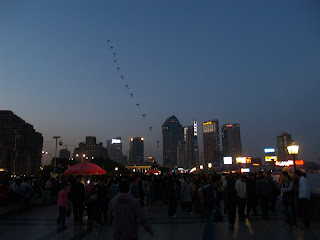
Sunday Photo Thread: Live from Tokyo Edition
So there hasn't been a weekend photo thread in months and I figured its time to mix it up a little bit. Though I'm without my beautiful Macbook Pro right now, I still have some photos that I can post. Since this blog is about all things China, not sure if I'll post many Tokyo shots, but here are some China shots that were sitting in the archives...



2008/04/25
And I Don't Wear Jerseys I'm 30 Plus...
The other night I had a discussion with a friend who is a true kicksologist, far above and beyond my own admiration for shoes of all kind, not just "gym shoes" (showing my Chicago pride with that). Growing up in Chicago during the 90s, Jordans were the shoes (as Spizike said, "it's gotta be the shoes") that everybody wanted, and I wasn't any different. Okay, I know it was true of the entire country, but hell, after being in China for awhile, you realize how important Jordan was. Jordan was Chicago, Chicago was Jordan. As I got older, I strayed away from my youthful obsession with Jordans, but after all these years, the release of the Air Jordan XX3, the final edition of numbered Jordans came out and I had to cop them immediately after seeing them. One more nod to my love of all things Chicago and final thanks to the man who took the Bulls from a laughing stock to league champions.
But nearing 28, am I too old to be rocking Jordans (especially the basketball high tops)? At what age is it time to start editing out that part of my wardrobe? Is Jay-Z right, is 30 the limit?
But nearing 28, am I too old to be rocking Jordans (especially the basketball high tops)? At what age is it time to start editing out that part of my wardrobe? Is Jay-Z right, is 30 the limit?
Lawyers Writing About China
China Law Blog did a post a few weeks back about English language blogs on Chinese law and last week I got some props from Black China Hand who talked about the number of lawyers writing blogs on China.
I have the utmost respect for the people on CLB's list who take the time to write blogs on Chinese law. While some of the people blogging are lawyers who use their blogs as a marketing tool, a number of excellent blogs are written by students. I am blown away by the quality of China Business Law Blog, all the posts are extremely in-depth analyses of Chinese law issues and are extremely educational. I cannot imagine myself taking the time to write such posts (instead of studying or going to a bar) back in my law school days.
My status as a lawyer has been kept on the down low since I started this blog, though from time to time I do touch on legal topics, but my recent back and forths with Chinese Lawyer Blog has sort of outted me, that's okay.
While I love the law and find Chinese law extremely interesting, I can't imagine using time away from the office to blog about legal issues. I deal with law enough in the office, I don't want to take it home with me. Therefore, while this blog touches on legal and political issues occasionally, the focus is still on my favorite extracurricular activities. Thus, the focus will remain on sports, art, brands, and (in the weeks to come) especially dining out. I would like to think that I can hit on some of the major happenings, the shops, the restaurants of Beijing, but its hard because I don't have the resources that City Weekend and That's Beijing have. There are a few helpers here, but we all have day jobs and this is only a labor of love.
Anyways, make sure to read those blogs if you want to know what's happening in Chinese law, but please also take the time to stop by here and find out what's happening on the ground in Beijing.
Olympic Ticket News Finally Released
Many in Beijing and around the country have been going to the Olympic ticketing website on a daily basis checking to see if Phase 3 tickets, which were supposed to go on sale in April, have been released yet. Well, on Wednesday, BOCOG finally held a press conference about Phase 3 ticket sales, stating that they will go on sale on May 5 at 9 am Beijing time.
Over 1 million tickets will go on sale during this round for many different sports including basketball, soccer, volleyball. Each account holder can purchase tickets for a maximum of 2 events (3 tickets per event). This round will be first come, first served.
During the press conference, BOCOG officials stated their confidence in the system and that there wouldn't be any problems like what went on during Phase 2 when the system crashed shortly after ticket sales began. They also denied the rumors that foreign students in Beijing are being encouraged (or forced) to leave Beijing as being completely baseless.
I'm sure by now everyone already knows about this as its 2 day old news, but if you don't know, now you know.
A Quick Look at Shopping Spots Around the Capital
With one less soldier on the ground (yes, a loyal contributor is now off to bigger and better things in Tokyo), we're a man down around here, but no problem, the slack can be picked up.
Speaking of picking things up, my mood was quickly picked up when I discovered a Beijing outpost of popular Shanghai wine bar/boutique Enoteca will be open soon at The Place. I imagine its going to be a very happening after work spot in the CBD. In other The Place related news, a Giordano Concepts will be opening by the end of the month there and, while there, its worth it to check out the Chinese brand Croquis, a brand based in Hangzhou that is a men's version of casual cool JNBY.
In other shopping news, Joy City's closer to capacity now that Zara has finally opened its doors. Tons of construction is going on at Xidan and the wrecking ball finally took out the many small stores facing joy city.
A walk through China Central Plaza mall saw a lot of "opening soon" signs and few customers (including a Muji). A large Brooks Brothers store is open now, but its still not known if BB's traditional "pinstripe lawyerly affectations" and "brash tweedy impertinence" will fit into this relatively empty area. Who is going to support this mall (more on this soon)? And how long do the apartment blocks squeezed between it and Xiandai Soho have before the wrecking ball comes calling?
Xinjiekou is in disarray as another large mall looks to be moving in next to the Xinhua Mall and many of the stores on the west side of the street are shut down, which could lead to major changes to the Chinese styles that are more commonly found in that area.
2008/04/23
What's Hot in China?
Yesterday I mentioned the Conde Nast Hot List (which rates the top new spots in the world) would be out soon (or at least up on line), and today that promise is fulfilled. China does alright in restaurants, but not so well in nightspots. Beijing's version of Whampoa Club makes it on the list, as well as Shanghai's Franck, Pure, and Hamilton House (are they taking credit cards yet?), with Hong Kong's Zuma (also on the Best 50 list) rounding it out.
5 places is respectable, but its still down from last year's high of 9. One wonders if Beijing's current pre-Olympics preparation turmoil caused the city to take a hit as a number of new establishments are only just getting up and running while costs have caused many to delay plans for a year or so. Perhaps, that's why there is only 1 spot on the nightlife list, Vue Bar in Shanghai.
Yet if you're in to spas, China takes the cake with 7 of the hottest new spas in the world. Beijing's Chi Spa, Jing-Chen Spa, Quan Spa, and Serenity Spa make the list as well as Shanghai's outpost of Quan and the Yuan Spa. From outside the Beijing-Shanghai-Hong Kong stronghold is Guilin's Homa Espirit Spa, also making the list.
World's Top 50 and Nothing For China
The yearly World's Best 50 Restaurants list has been released and no love for any restaurants in China, not that this is an overwhelming surprise. Pierre Gargnaire's self-named restaurant takes number 3, whereas his Hong Kong outpost comes in at 88 (the highest rated restaurant in Asia is Bukhara in India, at 55). All 4 L'Atelier Joel Rubochon's make the list, while the Hong Kong version Rubochon a Galera clocks in at 98, one ahead Zuma, another Hong Kong restaurant, at 99. Last year, lots of love was shown to Indian and Singaporean restaurants, but most of them are off the list this year and the above represents all the Asian dining spots on the list.
China's dining scene is still not quite ready for primetime, but the number of high end restaurants and outposts of foreign favorites is growing. Jean Georges gets on for his New York restaurant, will the Shanghai version be far behind? What about the amazing creations from the likes of Frederic Meynard (Le Pre Lenotre) and Paul Pairet (Jade on 36)? Will they get some international recognition in the years to come, especially after the Olympics, when the world visits Beijing? Restaurants like SALT, The Courtyard, and Jaan are putting out some great food, but their prices are still, compared to Tokyo, London, Paris, and New York, reasonable and perhaps this accessibility is what keeps them from these lists. Bloggers love lists and so I always go for this stuff, but is it unrealistic to think that a spot in China could compete in a few years (or even today)?
It will be interesting to see what Conde Nast Traveler's Hot List includes in its 2008 edition, as it regularly has a number of Chinese spots and is currently on newsstands. The website currently only has hotels and not the "hot" tables or clubs, China is well represented with Hotel Cote Cour SL in Beijing at 18, Shanghai's Jia (29) and Mansion Hotel (41), and the Kayumanis Nanjing (31).
2008/04/22
Massage Massage Everywhere...
With a hat tip to That's Beijing, I read curiously last week that there are officially 430 Blind Person Massage spots in Beijing, though as it seems there is one in almost every neighborhood, the number seems a bit small.
Massage is the first and still the main occupation available to the blind in China. While some work as piano tuners, operators, singers, or radio hosts, probably 95% or more of employed blind people serve as masseurs. Their training varies widely between those who have studied it through school and attended special education universities (like Changchun University or Beijing Union University) or schools of Chinese medicine, while many others only work as interns or trainees at massage parlours where they learn massage (a similar process to what Ben's blog talked about at hair salons). The government certifies those doing massage and parlours should have certificates on display (or at the very least, available).
The article mentions that the Beijing Disabled People's Federation has come up with a logo that certified parlours can display in an attempt to create a brand and build confidence among the public, especially in light of the upcoming Olympics. While this is a good plan, it doesn't always work. Masseurs, like the parlours they work at, are (or should be) certified by the government. Places that can be classified "Blind Person Massage" by the government get tax breaks and other benefits, so often regular massage places will "borrow" the certificates of blind masseurs for a fee so that they can be classified as "Blind Person Massage".
All part of the game. But if you're looking for cheap massage that can make you feel better (and feel good for what you're doing), look out for the new Blind Massage logo around Beijing.
Olympic Football (Soccer) Groups Out
I've been beaten to the punch by Shanghaiist (they even gave me a day, but yesterday was a long day, so I couldn't get it out before them) on this, damn! Gotta feel bad, even in my small little world of expertise, I still get pipped.
Anyways, for ticket holders (or those who want to buy tickets), hope you got the teams you wanted:
Men
Group A - Shanghai
Ivory Coast
Argentina
Australia
Serbia
Group B - Tianjin
Holland
Nigeria
Japan
United States
Group C - Shenyang
China
New Zealand
Brazil
Belgium
Group D - Qinhuangdao
South Korea
Cameroon
Honduras
Italy
Women
Group E - Tianjin
China
Sweden
Argentina
Canada
Group F - Shenyang
North Korea
Nigeria
Germany
Brazil
Group G - Qinhuangdao
Norway
United States
Japan
New Zealand
I don't know that much about women's soccer, so I'm not going to comment on that. It would appear to me that on the men's side, Group B is the "group of death" with 4 very powerful sides. China-Brazil is bound to be the big ticket match of the preliminary round, with the men's team returning to the city (but not the stadium) of its greatest success.
2008/04/16
All a Matter of Perspective
A point was hit home to me in a conversation with a friend the other day. Whether you love or hate the Chinese Communist Party (or fall somewhere in between), over the past 30 years, it has accomplished something absolutely amazing. The number of people who lived in poverty, many in absolutely disparate conditions, and no longer do thanks to the government's "reform and opening up" is larger than any society in human history has been able to accomplish. That figure has went from 250 million in 1978 to around 20 million today. Let me repeat that, in 1978 the figure was 250 million, today it is around 20 million (possibly even less). From 1997 to 2003, China went from 50 million people living below the poverty line to 25 million below the poverty line. These statistics are amazing and even when broken down to a percentage of the population, they are still unmatched.
Within that huge figure, there are a large number of Tibetans and other minorities included, something that is lost on many of the people currently protesting. China, because of its Communist government, is under a microscope where its many accomplishments ignored and its mistakes broadcast and bolded all over the world.
Things need to be kept in perspective.
Sad on a Tuesday
While it has been announced that many of the bars, clubs, and restaurants inside the gates of Worker's Stadium (Gongti) will be closed down during the Olympics, last night we showed up at Gongti planning on hitting up Kro's Nest for their great "I Hate Tuesdays" free (or RMB5) beer and decent pizzas and then heading over to Mix, trying to finally get rid of some of the thousands of RMB we have on multiple VIP cards, only to find Gongti all locked up and no way to enter the gate. Our guess was that the lockdown had something to do with the Good Luck Beijing Women's soccer event to be played at Gongti over the weekend, but some announcement would have been appreciated.
Instead, we went to Red Rose and had a decent time sitting outside on a lovely night, the menu is very hit and miss, but their yangrou chuanr are large and delicious (as well they should be for RMB6 a chuanr). We followed that by doing a round at some Sanlitun Hou Jie spots including Shooters (dead) and The Tree (hopping), followed by a trip to Suzie Wong's for their Latin night and one of the city's better mojitos.
The lack of announcements about location closings or street congestion is going to be a major problem if it continues, or worse, happens during the Olympics. Some of this information gets printed in Chinese, but often doesn't get to foreigners, others simply isn't announced and instead disappointed people don't find out until they arrive. The torch relay closed down the Tiananmen East subway stop and basically killed a morning for me. I currently am dealing with a client who is constantly complaining about the new visa rules that seem to be changing all the time and I'm starting to feel her pain.
UPDATE: Beijing Boyce explains the situation, oh well, pizza and beer will have to wait a week.
2008/04/15
Handing Out Bylines at Customs (Alternatively, "Drop a down payment on that Porsche Cayenne")
First off, I'd like to thank the reader "the NUN" for informing me of the New York Times article last week about Li Ning and Chinese brands as a whole. It's a very interesting look at Li Ning, the top Chinese sportswear manufacturer, but it often appears like this is the writer's first trip to China. I have a feeling that the closer we get to the Olympics, the more these sort of reporters will get bylines and so its going to get even more annoying. It's going to get to the point that when people get off the plane at Capital Airport, they walk through the brand, spanking new Terminal 3 and get handed a byline alongside a stamp in their passports, please, Mr. Nocera and your ilk, do your research!
He starts out giving a history of Li Ning, the athlete and the company, and about their "campus" in Beijing as well as some of the athletes the company has deals with, including Shaquille O'Neal. Then, he goes into the "similarities" between the Li Ning and Nike logo, as well as this line: "The Shaq figure stamped on his branded line of Li-Ning sneakers looked an awful lot like Nike’s Air Jordan figure." First, the Shaq logo looks absolutely nothing like the classic MJ logo. Beyond that, the logo is one that Shaq has been using almost his entire career and has spanned his time with Reebok, Starter, and now Li Ning (and probably a few other brands in between).
The article goes on to discuss how Li Ning, which dominated the Chinese market in the early to mid 90s before Nike and Adidas fully penetrated China, has fallen to number 3 in the Chinese market and has almost zero market penetration overseas. It claims that Li Ning holds 18% of the market, while both Nike and Adidas have over 20%, is this a negative? Where else in the world can a domestic sportswear company fight it out with these major players? It also fails to note that 3rd isn't so bad when you're talking about 18% in a country with 1.3 billion people and the fact that Li Ning is beating out all domestic competition as well as a number of major international players (Reebok, Puma, Converse, Kappa, etc) and doing all this with a marketing budget far less than that of Nike and Adidas.
Li Ning, if it attempts to go overseas, especially in the US and Europe, will have an uphill battle. The problem is that in China, it tries to market itself alongside Adidas and Nike, signing deals with major athletes, national teams, and sports leagues (the NBA and ATP, to name a few). The majority of items in a Li Ning store (including shoes) can be had for around RMB300 or less, the price that much of the clothing starts at in a Nike or Adidas shop. If they go downmarket overseas, they can bring in a ton of money, but will it hurt the brand image domestically?
Other Chinese brands mentioned in the article like Aigo and Lenovo (and some that are not like TCL and Haier) have gone a long way in attempting to enter the foreign market, but none of them are high-end producers, all are mid to low end players. For some, branding has been important, so much has gone into their marketing (for example, Aigo is one of the sponsors of the F1 Ferrari team), for Haier and others, their low, low prices (que Wal-Mart) and large distribution means less is spent on marketing. China's already spreading globally with these mid and low end products, more so than Japan in the 70s, but when and who will be China's first high-end brand to go abroad? This is what everyone is waiting for (often, at least in the west, very fearfully).
And what of the Porche Cayenne that Kanye sings about and I reference in the title? The article commits flaws of horrible research and talks about how Audi's are the height of luxury in China and how everyone wants an iPhone, which aren't even on sale here. Sure, an A6 is considered a "fancy" car, but the majority of people covet BMW's and Mercedes (or the extremely popular Cayenne). And iPhone's not on sale here? Hilarious!
Once more, reporters, please, please, please do your research and know something before coming to China, thank you.
2008/04/14
Real Advise to American Law Students (and Contracts are King!)
I recently saw a post on that great bastion of idealism and legal insight, the China Lawyer Blog, and found it pretty amusing as usual. At first, the start pulled me in by saying: “Many US law students are contacting me these days for advice about how to get a job and succeed while working at a Chinese Law Firm, like my law firm Zhong Lun. A few of them already work as interns in Chinese law firms.” I don’t advertise my involvement, but every now and then I bring up legal issues. Students and alumni at my law school and random blog readers write me from time to time with similar inquiries about what its like to work at a Chinese law firm.
To simplify what was already very simple, I’ll just offer the 3 lessons that he offered:
Lesson #1: If you do business with Chinese lawyers, get them to pay cash when they eat.
Lesson #2: An internship at a Chinese law firm means nothing and will not help you.
Lesson #3: An entry level job with a law firm is hard to get and will make your life miserable. And, you have no prospect of ever improving your status.
Let’s start with the first "lesson", if his accusation against Zhong Lun is true, its pretty hilarious. The very best Chinese law firms are structured and run not much differently from US law firms and usually partners would, without any thought and usually with a battle over who pays the check, be more than willing to throw down their credit card and cover the entire bill. In most cases, this meal would be reimbursed by the firm anyways. Zhong Lun is among the top Chinese firms, but if what Mr. Brauer says is true, its corporate culture is highly flawed and still very Chinese, not like the other top tier firms here.
The third one is an interesting issue to deal with. He’s stating a fact. Life in a law firm, be it in the US or China or England or wherever is going to be hard, especially for an entry level associate and it will be a miserable life for awhile. This is true if you are working at a top firm in Beijing or New York or London. Young Chinese lawyers working at the very best firms located in the CBD here are chained to their desk, just like young lawyers at Wall Street firms in New York. Much like lawyers at those Wall Street firms, everything will be based on performance, annual or semi-annual performance reviews will decide what your bonus and raise will be and are handled highly professionally. It’s cut-throat, even more so in the US because of the size of the population, but if a young Chinese lawyer doesn’t like it, they can choose to stay away from the most prestigious firms and instead go to a small firm in Beijing or a smaller city (lawyers in the US face a similar choice when job hunting).
The second one is a little harder, and is also somewhat factual. If you are a young US law school student and you get an internship with a Chinese firm (usually through a summer study program), it is unlikely the internship will help you very much. The only time I’d advise coming over for a summer program is after your first year of law school, during the second year, its time to line up a summer associate position with long term prospects. A US law student, even if they speak perfect Chinese, doesn’t have a very good understanding of Chinese law and won’t be able to do many of the things a Chinese law school student could do. The internship is basically just a line on the resume and in almost all cases, it won’t mean a lot of real world experience. Though, if one uses the time wisely and builds up contacts and friends within the firm and with foreign lawyers here, the time won’t be completely wasted and the internship may lead to future employment.
Most importantly, the post’s title is “Don’t Ask Me To Pay You, Idiot! Contracts Are For Fools” and in the article Mr. Brauer states that, “The difference is that it is impossible to enforce a contract against Zhong Lun, especially if you are foreign employee or client.” This is completely and utterly not true, it couldn’t be any further from reality. You NEED to have a contract, both for the obvious reason of setting up the terms of your labor and because it is required when a foreigner applies for a work visa as well as under the current Labor Contract Law (if you don’t have a contract, you benefit bigtime, any law firm worth its salt will sign a contract before you even start).
Chinese courts, much like US courts, aren’t going to spend a lot of time listening to hearsay. If you can prevent evidence to support your case, they will listen, no matter if you are a foreigner or a Chinese. A contract is the ultimate form of evidence in an employment dispute and it’s anything but impossible to enforce it in court. However, it is absolutely important to have every term that is negotiated between the two parties included in the contract, verbal promises made in conversations that aren’t memorialized in the contract can’t be protected. Put it in writing! Let me repeat that, and let that be the only lesson here, PUT. IT. IN. WRITING. If you do so, and if the end result is a day in court, your day will be much smoother.
It is not easy getting a job in the China legal market and if you’re an American law student who isn’t a Chinese citizen, you are facing an uphill climb. Getting an internship with a Chinese law firm during your 1L summer is a good way to start climbing that hill. It is tempting to take an offer from a Chinese firm as there are very few that are willing to even consider foreigners for summer (or any) positions, but make sure it is the right firm. It will make all the difference in the world, a great firm may not give you a long-term offer, but the partners are likely to have contacts at foreign firms and will be willing to give you a hand. This is important, contacts matter, they matter a lot and go a long way in whether you can find a job. Being highly competent in reading and writing Chinese, especially legal Chinese, will be beneficial. Even in that case, its still a crap shoot in the end.
2008/04/01
Dining Scene Notes
From a weekend of roaming around, there are two interesting dining issues to note. First, a branch of S'Silk Road (茶马古道) will soon be coming to the re-branded version of XinDongAn. It seems like a strange fit for this upscale restaurant, especially with the recent opening of a very large Yunnan restaurant in that mall. It will be interesting how they try to shoehorn their artsy, stylish restaurant into this far from upmarket mall (even with all the changes).
Major changes at the recently reopened Courtyard as well. The art gallery downstairs is no more and will probably be used for more tables or private dining. Also, no more art on the wall, replaced instead by a large mirror running the length of the back wall. The Cigar Divan upstairs may also be a thing of the past. Yet the food, as always, is still excellent and worthy of a splurge from time to time.
Lots of good things are being said about the new Cuban restaurant, Guantanamera, near the Kuntai Hotel, plan on stopping by sometime in the near future for a mojito and to see the nightly live music sessions.
Subscribe to:
Posts (Atom)


